
AI transparency
We use AI where it takes work off our hands, and we say openly where. This page shows which content on seeside.ai is created with AI, how we label it and who is responsible for it.
As of 28 September 2026
Where we use AI
- Texts
- We draft the texts on this website with AI support. We check facts and figures against sources before they go online. Thomas Honold is responsible for all content (see legal notice).
- Images
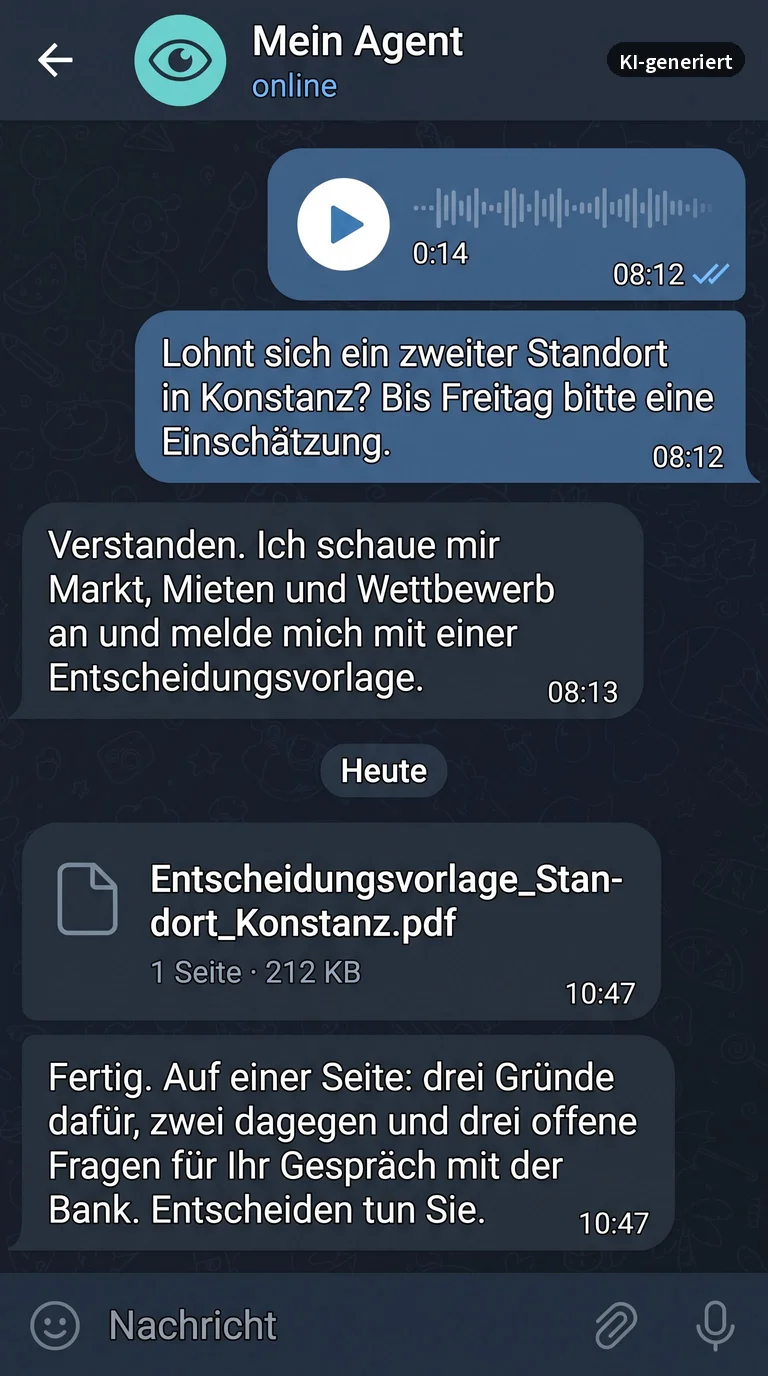
- One image on this website is AI-generated: the example chat in Telegram on the home page. It shows how working with a personal agent looks and is not a real client conversation.
- 3D renders
- The images of the ARS 200 roller on the projects page are renders from Blender, not photos. An AI agent built the 3D model by script; the captions say so.
- Screenshots
- Screenshots of client websites and of our own projects show these sites as they are online. If they contain AI images, these are labelled on the respective website.
- No chatbot
- No chatbot talks to you on this website. Messages from the contact form reach a person.
How we label AI images
- Below the image
- A visible line: “Image: AI-generated”. It is part of the page, so screen readers read it too.
- In the image
- A small “KI-generiert” (AI-generated) label, so the note stays when the image is shared.
- In the image data
- The international marker IPTC Digital Source Type “trainedAlgorithmicMedia”, which search engines and social networks read.
- Real photos stay unlabelled
- Real photos, such as the portrait of Thomas Honold, are not labelled as AI, because they are not.
What we do not do with AI
- No AI faces for real people
- We show people only in real photos.
- No invented clients, quotes or figures
- Examples are marked as examples, figures come with a source and a date.
Legal framework
Since 2 August 2026, the transparency obligations of Article 50 of the EU AI Act (Regulation (EU) 2024/1689) apply. This page documents how we implement them. For staff who work with AI, Article 4 also requires measures for AI literacy. What that means for companies is explained under AI training for employees under Article 4 of the AI Act.
Questions
Questions about AI on this website go to Thomas Honold: kontakt@seeside.ai · Legal notice
Questions about AI labelling
Is there an AI labelling requirement?+
Yes. Since 2 August 2026, Article 50 of the EU AI Act has required AI labelling. Anyone publishing AI images, videos or audio that look deceptively real (deepfakes) must disclose it. AI texts on matters of public interest also need a notice, unless a human has reviewed them and holds editorial responsibility.
How do you label AI-generated images?+
We label AI-generated images on three levels: the line “Image: AI-generated” below the image, a small label in the image and the IPTC Digital Source Type marker “trainedAlgorithmicMedia” in the image data. That way the notice stays even when the image is shared.
Do texts written with AI have to be labelled?+
Only in certain cases. Texts on matters of public interest need no AI notice if a human has reviewed them and holds editorial responsibility. Our texts are written with AI support, we check facts against sources, and Thomas Honold is responsible for them.
Does every image have to be labelled as AI?+
No, only images that an AI has created or altered. Real photos, screenshots and our 3D renders from Blender are not labelled as AI because they are not AI images. An AI notice on a real photo would itself be misleading.